The Man Who Saved Pennsylvania’s Forests Returns Home on Earth Day
BY BRIAN CARSON
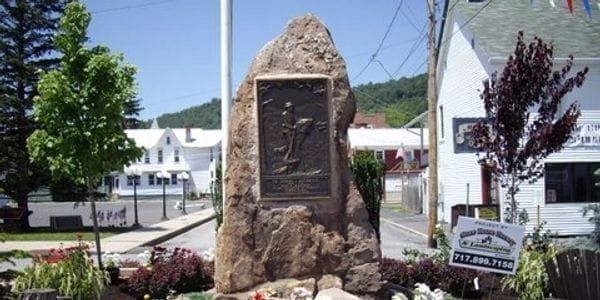
MCVEYTOWN — On an April afternoon in McVeytown, as the hills above the Juniata turn the pale green of early spring, people will gather at the corner of John and Market streets beside a stone monument that has stood for more than a century.
They’ll come on foot and by car and stand before the carved likeness of a man whose life helped shape the forests rising beyond the town. At 2 p.m. today, on Earth Day, the Juniata River Valley Visitors Bureau will host a ceremony honoring Dr. Joseph Trimble Rothrock, a native son widely known as the father of forestry in Pennsylvania.
The date is deliberate. Rothrock Week is observed each year during the last full week of April, and this year the observance once again coincides with Earth Day. Representatives from the Pennsylvania Department of Conservation and Natural Resources and the Bureau of Forestry are expected to attend. Their presence carries a historical symmetry. In 1895, Rothrock became the first commissioner of the Bureau of Forestry, a position that placed him at the center of one of the most consequential conservation efforts in the state’s history.
“Rothrock’s legacy is all around us, from our scenic overlooks to our forested trails,” said Jenny Landis, executive director of the visitors bureau. “By honoring Dr. Joseph Rothrock, we’re also celebrating the natural beauty that draws visitors to the Juniata River Valley and inspires people to explore it.”
That the ceremony takes place in McVeytown is fitting. Rothrock was born there on April 9, 1839, in a small rural community where agriculture and the rhythms of the natural world shaped daily life. As a boy, he attended the Tuscarora Academy in neighboring Juniata County, traveling back and forth across hills and valleys that would later come to define his life’s work. Those early years left their mark. The fields, streams and wooded ridges of the Juniata Valley were not abstractions. They were home.
Rothrock’s path was unusually broad for a man of his era. He studied at Harvard, where he pursued botany, and later earned a medical degree from the University of Pennsylvania. The Civil War interrupted his studies. He enlisted in the 131st Pennsylvania Infantry and was wounded at the Battle of Fredericksburg. While recovering in an army hospital, he shook hands with President Abraham Lincoln, who offered encouragement. It was a moment he would remember for the rest of his life.
After the war, Rothrock practiced medicine and taught botany. He traveled west on expeditions to study and collect botanical specimens. He was, by temperament and training, both scientist and physician, equally at ease in the field and in the lecture hall. Yet it was the condition of Pennsylvania’s forests that would come to command his deepest concern.
By the late nineteenth century, much of the Commonwealth’s woodland had been cut over and left barren. Timber companies stripped hillsides of white pine and hemlock, feeding furnaces and mills that powered a growing industrial state. What remained were barren slopes, prone to fire and erosion. Floods became more frequent. Streams once shaded by a thick canopy ran warm and muddy. The damage was visible and, to those who looked closely, alarming.
Rothrock looked closely. He spoke publicly about the need for forest management and conservation. In 1886, the Pennsylvania Forestry Association was formed, and Rothrock became its first president. He argued that the state must purchase and protect cutover lands before they were lost entirely. His ideas were not universally embraced. The notion that forests should be conserved rather than exhausted ran against the prevailing economic current.
Still, progress came. In 1895, the state legislature created the Bureau of Forestry within the Department of Agriculture, and Rothrock was appointed its first commissioner. From that office, he established training programs for foresters and oversaw the acquisition of tens of thousands of acres of stripped, abandoned land. Much of what would become Rothrock State Forest was secured in those years, including vast stretches of the Seven Mountains.
The work did not end with his tenure. In the 1930s, during the Great Depression, the Civilian Conservation Corps set to work in Pennsylvania’s state forests. Young men built roads and trails, planted trees, constructed cabins and restored landscapes once thought beyond repair. Their labor reshaped the land in ways that endure to this day. Four state parks within Rothrock State Forest, including Greenwood Furnace and Whipple Dam, owe much to those efforts.
Rothrock died in 1922 at the age of 83. Two years later, on Nov. 1, 1924, the monument in McVeytown was dedicated in his honor. Gov. Gifford Pinchot spoke at the ceremony, calling Rothrock one of the greatest public servants in the history of the Commonwealth. Over time, his name has been attached to forests, plaques, markers and observances. Arbor Day in Pennsylvania was once held on his birthday. Conservation Week was proclaimed in recognition of his influence.
Yet the most enduring tribute lies beyond any monument. It rises in the ridges and valleys of central Pennsylvania, in forests once cut to stubble and now thick with oak, maple and pine. Hikers traverse the Mid-State Trail. Anglers cast lines in shaded streams. Families gather beneath trees whose existence owes something to decisions made more than a century ago.
On Earth Day, when people gather again at the Rothrock Monument, they’ll take part in a tradition that links past and present. The ceremony will be modest in scale, as these gatherings often are. There will be remarks, expressions of gratitude and reflection. The setting itself will do much of the speaking.
The story of Joseph Rothrock isn’t confined to the nineteenth century. It lives in the forests that stand today across the Juniata Valley and beyond. On an April afternoon in McVeytown, beneath a spring sky, the stone monument will cast its shadow as it has for generations. Around it, the town will carry on. Beyond it, the hills will remain, green and enduring, a reminder of a life spent believing that land, once saved, can be restored.





Member discussion