Four Runners, One Baton, and the Fastest Moment in Mifflin County History
BY BRIAN CARSON
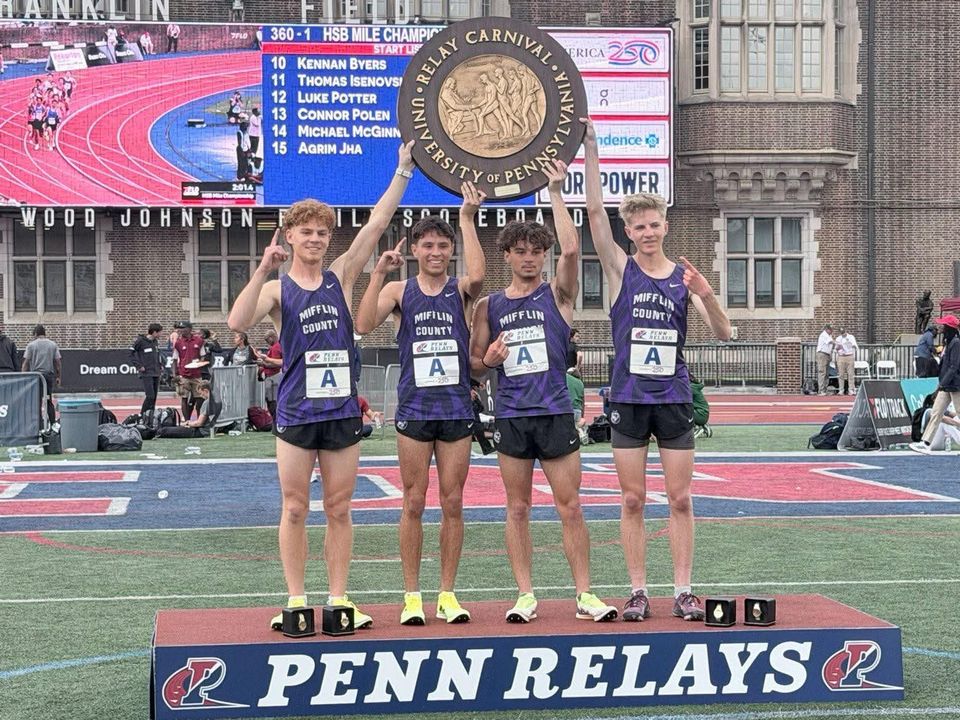
For nine minutes and 54.01 seconds, four young men from Mifflin County carried a baton around Franklin Field and made the old place remember their names.
That’s the thing about a relay. Nobody owns it for long. The race comes to you, hot and urgent, then leaves your hand. You get your stretch of track, your turn with the lungs burning, your few seconds before the stadium turns into noise.
Then you have to trust the next guy.
Reese Cubbison handed it to Connor Lynch.
Lynch handed it to Wyatt Kauffman.
Kauffman handed it to Carter Smith.
Smith handed it to the clock.
The clock answered. Mifflin County won the distance medley relay at the Penn Relays this weekend in a record time of 9:54.01. Before that, the same foursome won New Balance Indoor Nationals in a meet-record 10:05.09.
That sentence looks simple until you sit with it.
Mifflin County. Penn Relays. Record time.
Those words don’t usually stand together.
Around here, athletes often grow up measuring themselves against places with more students, more money, and more depth. The bigger schools have larger hallways, deeper rosters, and more margin for error. They can lose a runner and replace him. They can have an off day and still survive.
Mifflin County has to get more out of what it has. It has to develop. It has to believe early and wait long. It has to make four athletes good at the same time, then make them brave enough to find out how good they really are.
That’s where Alex Monroe matters. A coach can’t run the race for them. He can’t take the baton, can’t close the gap, can’t give their legs one more gear when the bell lap turns cruel. But a coach can build the belief before the belief has evidence. He can see the shape of a team before the rest of us see anything more than four runners with talent.
Monroe’s work lives in the parts of this story that won’t show up beside the record time. It lives in the training plan, the order of the legs, the corrections, the patience to let young runners become national runners one hard day at a time. When a relay team stands on a stage like Penn Relays and looks ready for it, that doesn’t happen by accident. Somebody helped teach them how to carry the moment before they ever carried the baton.
The distance medley relay is a strange piece of track architecture. It asks different things from different people. One runner opens the door. One keeps the house standing. One stretches the race. One closes it.
There’s no hiding in it. The baton exposes everyone. A relay has no private suffering. If one leg cracks, the whole thing feels it. If one exchange goes wrong, the race can fall apart in a second. If one runner panics, the clock punishes all four.
That’s what makes a great relay team rare. Talent gets you to the line. The rest comes from rhythm and trust.
Four runners have to agree, without saying it, that the race belongs to all of them. Each one runs alone while carrying the weight of everyone else.
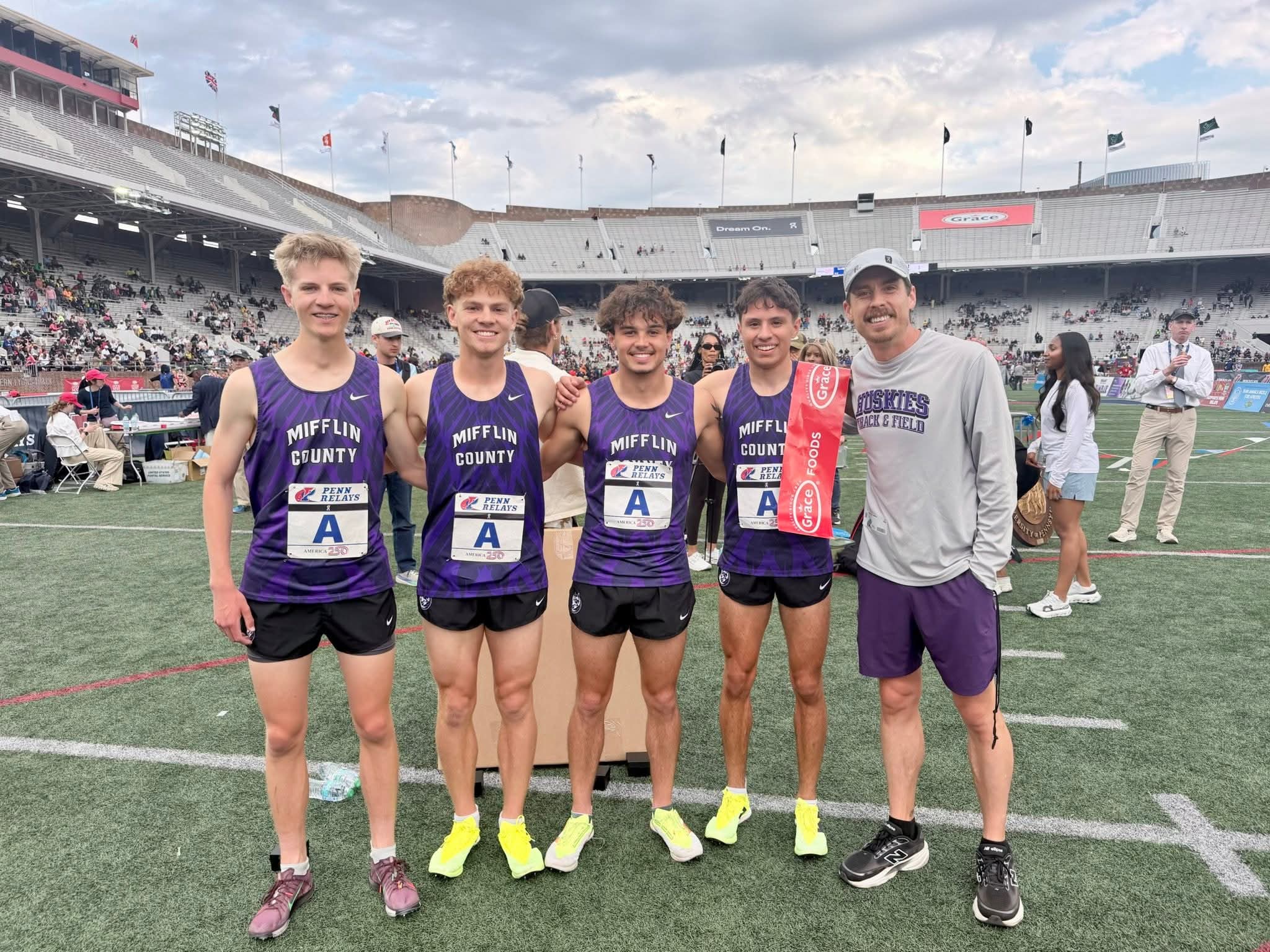
Cubbison, Lynch, Kauffman, and Smith did that at New Balance Indoor Nationals. They did it again at Penn Relays, inside the weather and theater of one of the sport’s grandest stages. They repeated success, then lowered the standard. They put a new time on the board.
Records do something trophies can’t quite do. Trophies say you won the day. Records say you changed the measurement.
For as long as it stands, 9:54.01 will sit there with their names attached to it. Mifflin County will be attached to it, too. Coaches will point to it. Runners will chase it. People who don’t know these young men will know what they did before they know anything else about them.
That’s the odd bargain of sports. Years get reduced to numbers.
A winter of miles becomes 10:05.09.
A spring of work becomes 9:54.01.
Four young lives, full of homework and practices and ordinary teenage mornings, become one clean line in a record book.
Anyone who has watched a serious runner knows the number never tells the whole story. Track looks simple from the bleachers because the sport strips everything down. No pads. No helmets. No timeouts. No huddle, where a tired athlete can disappear inside the group. Just the oval, the body, and the clock.
The simplicity fools people.
Running at that level requires a kind of daily obedience most people would find unreasonable. You train when nobody claps. You hurt when nobody knows. You learn the difference between pain that warns you and pain that wants you to quit.
Then, after all that, you show up at Franklin Field and run as if the moment belongs to you.
That’s what Mifflin County did.
There’s a local temptation to treat national success like a happy accident. A group of kids catches fire. A team gets hot. A few things break right. Everybody cheers, then life goes back to normal.
This had too much evidence behind it.
A team doesn’t win New Balance Indoor Nationals with a meet record and then win Penn Relays with a record time because the wind liked it. A team doesn’t go 10:05.09 indoors and 9:54.01 outdoors because fortune smiled twice.
At some point, achievement stops looking like surprise and starts looking like proof.
This team has proof now.
It has proof that runners from Mifflin County can stand in lanes beside anybody. It has proof that the ceiling was higher than people thought. It has proof that the old excuses about size, geography and resources sound thin when four boys keep making the clock move out of their way.
That might be the best part. A performance like this travels backward and forward at the same time.
It travels backward to every morning workout, every lap, every sore leg, and every decision to keep going. It travels forward to the younger kid in Mifflin County who now has a different picture in his head.
That kid doesn’t have to imagine some faraway powerhouse doing this. He can imagine athletes from his own county. He can imagine the same uniform. He can imagine the baton coming to him.
That’s how programs grow. Someone does something that looks impossible. Then it becomes a story. Then it becomes a standard.
Cubbison, Lynch, Kauffman, and Smith gave Mifflin County a standard.
Monroe helped give them the road to reach it.
They gave it a moment that should be allowed to breathe. In sports, we rush too quickly to what’s next. The next race. The next meet. The next record. The next chance to prove the last thing was real.
Sometimes the last thing already proved enough.
Four runners went to the Penn Relays and won. Four runners made history. Four runners gave their county a reason to say their names in order, like the legs of the race itself.
Reese Cubbison.
Connor Lynch.
Wyatt Kauffman.
Carter Smith.
The baton moved. The record fell. The clock stopped at 9:54.01.
For a little less than 10 minutes this weekend, Mifflin County didn’t have to explain where it was, who it was, or why it belonged on that stage.
It just ran.



Member discussion